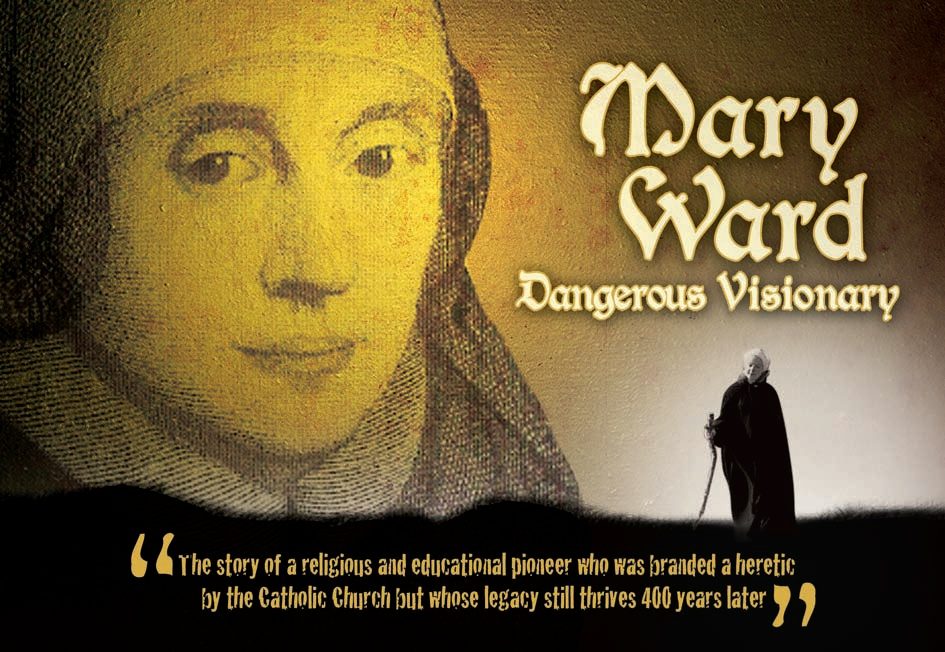
‘The Painted Life’ is a series of fifty paintings which illustrate significant events in the life of Mary Ward. The paintings are displayed in the the ‘Mary Ward Hall’ at the CJ convent in Augsburg, Germany, together with other artefacts owned and used by Mary Ward. These include a pair of shoes, which she wore on one of her journeys on foot across the Alps to speak with the Pope about her Institute.
The paintings measure 142 x 105cm and show her spiritual journey. Very little information has come down to us as to the origins of the paintings. It is most probable that they were painted by various artists somewhere between Flanders and the Tyrol in the second half of the seventeenth century. There is written evidence that places them in Munich between 1680 and 1717, but how they came to Augsburg is unknown.
The initiative to commission the paintings must have come from Mary Ward’s first companions as the paintings tell the story of her life in considerable detail. Writing her life would have been risky as Mary Ward’s Institute had been condemned by the Church. Commissioning a series of paintings that told the story diminished the risk of ecclesiastical censure – though not entirely. At various times the local bishop ordered their removal from the walls of the Augsburg Convent. During the Second World War the paintings were removed and hidden, and therefore survived the destruction of the Augsburg convent.
The earlier paintings are better artistically than the later ones, and tell the story of Mary Ward’s early life, her vocation and the founding of her institute. Many of the later ones are artistically not remarkable but they contain a series of deep spiritual experiences that are not known from the written sources.
The inscriptions on the paintings are written in German and were most likely added at the end of the seventeenth century after the completion of the pictures.
Copyright ‘Painted Life’ Pictures. Mary Ward Spirituality Centre, Augsburg. Photo Tanner, Nesselwang, Germany.